

Whether you are looking to buy land in Romania for development or are considering buying property in Romania as a long-term investment, navigating local real estate laws is critical. Our legal team provides comprehensive due diligence and transaction support to ensure your acquisition is secure, legally sound, and fully compliant with Romanian regulations for foreign investors.
What laws apply to foreigners buying real estate in Romania?
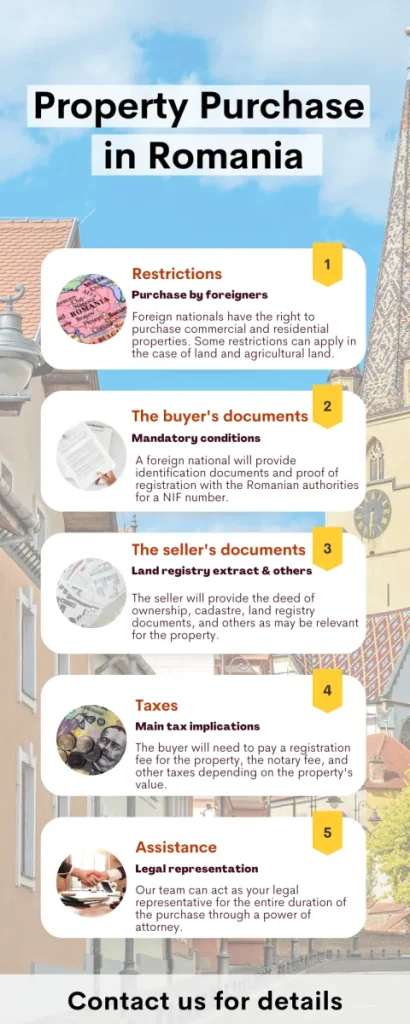
The Romanian Legal System establishes precise regulations concerning the matter of ownership right over real estate in Romania. There are several distinct instances that must be explained in order to fully understand the overall legal approach. Foreign citizens can acquire real property in Romania, but only on certain conditions.
| Quick Facts | Details |
|---|---|
| Nationality restrictions: "For buildings and apartments: No. For land: yes, citizens and companies of non-EU/EEA states can acquire land only under an international treaty, on a reciprocity basis." | No |
| Land purchase restrictions (Yes/No) | Yes, in some cases |
|
Agricultural land purchase |
Possible for natural and legal persons, subject to the pre-emption rights and buyer conditions of Law no. 17/2014 (agricultural land outside built-up areas) |
| Special approvals from the authorities in Romania |
Not ordinarily |
| Real estate due diligence | Foreigners buying property in Romania are advised to perform a comprehensive verification, assisted by an expert, such as one of our lawyers |
| Property documents analysed for due diligence purposes |
Land Registry extract, relevant fiscal documents, mortgages, compliance with the ongoing rules for water/gas pipes, construction permit compliance, environmental issues, and others on a case-by-case basis |
| Documents required from foreigners buying property in Romania |
Identification documents (passport for natural persons), corporate documents (when the buyer is a legal person established in another state) |
| Mandatory documents required from the seller | The deed of ownership, the cadastral documents, land registry extract, energy performance certificate and others |
| Property purchase through a local representative | The foreign national can appoint a local representative to handle the purchase through a power of attorney |
| Special steps for foreigners buying property in Romania | The individual needs to apply for a fiscal identification number (NIF) with the National Agency for Fiscal Administration |
| Taxes for property purchase in Romania | Tax on the sale of property held by individuals: 3% of the transaction value if the property was held for up to 3 years, 1% if it was held longer, calculated on the whole value (the 450,000 lei tax-free threshold was abolished in 2023); the notary computes and collects it Land Registry (ANCPI) registration fee Notary fees |
| Special building permits | Subject to the construction law requirements for renovations/modifications and the special regime for protected buildings/historical monuments |
| Post-purchase steps | Local tax registration within 30 days of the sale/purchase agreement authentication date Notary tabulation registration Changes to the utility agreements |
| Assistance for property purchase in Romania | Upon request, complete solutions from our team for foreign nationals willing to purchase apartments, homes, commercial or residential complexes in the country |
Before going into details, our team of real estate lawyers in Romania wishes to draw attention to some specific aspects regarding the legal status of foreign nationals. We will further distinguish between three major classes: foreign citizens, stateless persons and legal entities. These are the most significant groups, representing individuals or juridical personalities who can fall under the ownership rights regulations. Legal information about buying real estate in Romania reveals several different circumstances.
Are there restrictions on foreigners buying apartments or commercial buildings in Romania?
No. Romanian law places no restrictions on foreign citizens, stateless persons or foreign companies, whatever their country of origin, who want to buy apartments, houses, commercial or industrial buildings in Romania. They acquire ownership of these properties under the same conditions as Romanian citizens.
The restrictions concern only the land. EU/EEA citizens and companies can also acquire the land under the building under the same conditions as Romanian citizens. Citizens and companies of other states can acquire land only where an international treaty allows it, on a reciprocity basis, or by legal inheritance (Article 44 of the Romanian Constitution and Law no. 312/2005). Otherwise, a right of superficies (the right to use the land under the building) is established in their favour, or the property can be bought through a company registered in Romania, which can own land whatever the nationality of its shareholders. Our real estate lawyers in Romania can provide more information on the legal implications.
Do I need residency to buy a property in Romania?
No. You do not need a Romanian residence permit or a Romanian address to buy a property in Romania. You only need a Romanian tax identification number (NIF), which non-residents obtain from the National Agency for Fiscal Administration (ANAF) before signing at the notary. Our lawyers can obtain it on your behalf, based on a power of attorney. Residency does not change the rules on land: they depend on your citizenship, as explained above.
What laws apply to EU citizens buying real estate in Romania?
We would like to inform you about the ownership right over Romanian Real Estate for EU citizens, EU domiciling stateless persons and legal entities formed in an EU member state or belonging to the Economic European Area.
Land acquisition by foreigners is governed by the Romanian Constitution and by Law no. 312/2005. Article 44 paragraph (2) of the Constitution establishes that “Aliens (foreign citizens) and stateless persons may acquire private ownership of lands only under the terms as may arise from Romania’s accession to the European Union and from other international treaties to which Romania is a party, on a reciprocal basis, in accordance with an organic law, as well as by way of statutory inheritance.”
Under Law no. 312/2005, the rules for EU/EEA nationals are the following:
- citizens of EU/EEA member states, stateless persons domiciled in an EU/EEA member state or in Romania and legal entities established under the law of an EU/EEA member state can acquire ownership of land in Romania under the same conditions as Romanian citizens and Romanian legal persons, whether or not they are resident in Romania;
- they can also acquire agricultural land, forests and forestry land under the same conditions as Romanian citizens and Romanian legal persons; the sale of agricultural land located outside built-up areas is subject to the pre-emption rights and other conditions of Law no. 17/2014.
If you need to know more about one or both of these situations, please reach out to our real estate lawyers in Romania.
What law applies if I want to buy agricultural land in Romania?
The ownership right over agricultural land (outside and inside the built-up areas), forests and forestry land can be acquired by citizens of an E.U. member state, stateless persons domiciled in Romania or in an E.U. state member, as well as legal entities established according with legislation of an E.U. member state. The experts at our law firm can help foreign investors buy land in Romania.
However, the sale of agricultural land located outside built-up areas must observe the pre-emption right provided by Law no. 17/2014, in this order: co-owners, spouses, relatives and in-laws up to the third degree; owners of agricultural investments on the land and/or lessees; owners and/or lessees of neighbouring agricultural land; young farmers; agricultural research and education institutions (for research land); natural persons domiciled in the same or a neighbouring locality; and, finally, the Romanian state through the State Domains Agency. If no pre-emptor accepts the offer, the land can be sold to natural or legal persons that meet the conditions of the law (e.g. residence or registered office and agricultural activity in Romania for at least 5 years) and, only if none of them qualifies, to any person.
The right of first refusal is a statutory pre-emption right that gives its holder the option to enter a transaction with the owner of a terrain, in this case before the owner is entitled to enter into that transaction with a third party. Not respecting the right of first refusal invalidates the sale contract.
Investors who wish to purchase agricultural land in Romania can receive personalized information and advice from our Romanian lawyers.
How can I buy land in Romania?
For agricultural land located outside built-up areas, the first step is made by the seller, who must register a request at the city hall where the land is located in order for the offer to be displayed for 45 working days.
The request to display the offer must be accompanied by the offer to sell, information on the land and the seller along with cadastral documents. Our lawyers can help you check these documents and buy land in Romania.
This request benefits the preemptors who have the right to manifest their intention to buy the land, to accept the offer and to register it at the city hall within 45 working days of the display of the offer to sell.
If no preemptor manifests his/her intention to buy the land, it can be sold to the potential buyers who meet the conditions of Law no. 17/2014 (and, if none qualifies, to any person); in all cases, the sale contract can be concluded only on the basis of the approval (aviz) issued by the Ministry of Agriculture through its central structure or county directorate. Subsequently, the sale can be authenticated by a public notary or it can be replaced with the Court’s ruling.
Before commencing the purchase phase, due diligence in Romania is recommended and our law firm provides this service on demand.
How does the pre-emption procedure work in practice?
Within 10 working days of the seller's request, the city hall notifies the pre-emptors at their domicile or registered office, or, if they cannot be reached, by posting a notice at the city hall or on its website. The offer is also published for 15 days on the website of the Ministry of Agriculture or of its county agricultural directorate. Within each rank of pre-emptors, the law sets further conditions and priorities:
- Owners of investments and tenants: owners of orchards, vineyards, hop plantations or private irrigation systems on the land have priority over the tenant. A tenant can exercise the right only under a valid lease concluded and registered at least one year before the offer was posted, and only if the tenant has had its domicile or residence in Romania for the 5 years before the offer was registered. For a tenant company controlled by another company, the controlling shareholders must have had their domicile, residence or registered office in Romania for those 5 years.
- Neighbours: priority goes to the owner whose land shares the longest side of the plot. If the plot has two long sides or equal sides, a neighbouring young farmer domiciled in Romania for at least one year has priority; the other neighbours follow in decreasing order of the length of their common border. If the long side borders land in another municipality, the neighbour domiciled in the municipality where the plot lies has priority.
- Young farmers: persons aged up to 40, as defined in the EU rural development rules, who carry out or intend to carry out agricultural activities. Among them, a young farmer working in livestock farming and domiciled in Romania for at least one year has priority.
If several pre-emptors accept the offer at the same price and on the same terms, the order of ranks decides. If a lower-ranked pre-emptor offers a higher price, the seller may restart the procedure once at that price, within 10 days after the 45 working days end; acceptances of the new offer must be registered within the following 10 days. The seller may withdraw the offer before the 45 working days end. If the seller changes the offer, the procedure starts again.
Who can buy agricultural land if no pre-emptor accepts the offer?
Law no. 17/2014 treats citizens and companies of Switzerland in the same way as those of the EU and EEA, and stateless persons domiciled in Romania, the EU, the EEA or Switzerland in the same way as citizens. Buyers from other countries can acquire agricultural land only where an international treaty allows it, on a reciprocity basis.
If no pre-emptor accepts the offer within the 45 working days, other potential buyers may file their documents at the city hall within the following 30 days. They can buy only if they meet all of the following conditions:
- Individuals: domicile or residence in Romania for at least 5 years before the offer was registered, agricultural activity in Romania for at least 5 years, and registration with the Romanian tax authorities for at least 5 years.
- Companies: a registered office or secondary office in Romania for at least 5 years, agricultural activity in Romania for at least 5 years, at least 75% of total income in the last 5 fiscal years from agricultural activities, and controlling shareholders domiciled in Romania for at least 5 years (or, where they are companies, with their registered office in Romania for at least 5 years).
Only if no potential buyer meets these conditions may the land be sold to any natural or legal person. The land may not be sold at a lower price or on better terms than those in the posted offer; doing so, or selling to a buyer who does not meet the conditions, makes the sale absolutely void.
Which approvals are needed, and when do these rules not apply?
The Ministry of Agriculture checks the chosen pre-emptor or buyer within 10 working days after the relevant deadline and issues its approval within the following 5 working days, or a negative opinion if the conditions are not met. The approval is issued by the county (or Bucharest) agricultural directorate for plots of up to 30 hectares and by the Ministry's central structure for larger plots. It is valid for 6 months from its communication to the seller, or longer if the parties sign a promise to sell or an option agreement within that period.
Additional approvals may be needed:
- land within 30 km of the state border or the Black Sea coast, or within 2,400 m of special sites, can be sold only with the approval of the Ministry of National Defence; this does not apply to sales to pre-emptors;
- land with archaeological sites or areas of archaeological interest requires the approval of the Ministry of Culture, and land with classified archaeological sites is sold under the law on historic monuments;
- both opinions must be given within 20 working days, failing which they are deemed favourable.
A court ruling can replace the sale contract only if the preliminary contract was validly concluded, the pre-emption rules and approvals were observed, and the land is registered with the tax authority and in the land register.
The procedure does not apply to sales between co-owners, spouses, or relatives and in-laws up to the third degree when the owner has not asked for an offer to be posted at the city hall, nor to sales in enforcement proceedings or by public auction, such as in insolvency proceedings or when local or county authorities sell land from their private domain.
What obligations does the buyer have after the purchase?
From the date of purchase, the owner must use the land exclusively for agricultural activities and must keep the agricultural use of any orchards, vineyards, hop plantations or private irrigation systems on it.
If the land is resold within 8 years of its purchase, the seller owes a tax of 80% of the positive difference between the land's value at the time of resale and at the time of purchase, based on the notaries' reference values. The notary calculates and collects this tax before authenticating the sale. The same tax applies when a controlling stake (more than 50%) in a company is sold within 8 years of the company acquiring such land, if the land represents more than 25% of the company's real estate assets. The tax is due in addition to the taxes under the Fiscal Code, and income obtained by non-residents from these transactions is not covered by Romania's double taxation treaties. A sale made without paying this tax is voidable.
Are there any risks in buying land?
Before buying a land in Romania, there are a few documents you either have to verify or obtain:
- Real Estate Register Excerpt is proof of ownership of the seller and it must be up to date.
- If the real estate register excerpt indicates that the seller is the owner of the property, as there is no prohibition of alienation and encumbrance of real estate and there are no bonds on the property, you ask the seller to show you the title under which it has acquired ownership.
- Cadastral documentation, to make sure that the field you want to buy has the mentioned area in the real estate register and the location indicated by the seller.
- Urbanism certificate, in building construction, plot of land must present certain characteristics and meet certain requirements, depending on the placement of the land.
- Tax Certificate, issued by local authorities, it represents the written stating concerning whether or not there are existing debts to the local budget on the property.
This urbanism certificate is issued by local authorities and is valid for the period set by the issuing authority (usually between 6 and 24 months), and can be extended once by up to 12 months, and it provides information on: required minimum building site area, minimum distances from the neighbors’ land, minimum size of the opening, the maximum height allowed, land occupancy percentage (POT), the land use coefficient (CUT). In addition to the information contained in the certificate of urbanism, information on local rules set for construction is provided by Urban Area Plan (PUZ).
Our Romanian lawyers can provide complete information on obtaining these documents. Upon request, our attorneys can also help you with legal representation in front of the authorities and act as an authorised representative to apply and obtain these documents, so do not hesitate to get in touch with our team if you want to buy land in Romania.
What legal risks are specific to properties in Romania?
Some problems are specific to the Romanian market and do not always show up in the documents presented at the notary:
- properties confiscated by the communist regime that are subject to restitution claims, some of them still in litigation, whose title can be challenged;
- buildings under construction: until the building is completed and registered in the land register, you are buying a future property, usually through a promise to sell, and you depend on the developer finishing it;
- buildings in a bad state which are on an official list of being dangerous in case of an earthquake (Bucharest, for example, is an earthquake zone).
Is real estate due diligence mandatory when buying a property in Romania?
No, the law does not require it, but we strongly advise it. The notary checks the documents needed for the contract, such as the land register extract and the tax certificate, not the full legal history of the property, its permits or the risks above. A due diligence report covers them before you pay the advance.
Can you help me run a property verification in Romania?
We have established an expert team of Romanian lawyers, committed to develop creative and professional solutions adapted to our clients` business interests. Our lawyers can definitely run a real estate due diligence procedure in Romania and help you make the best decision when purchasing property in this country.
The team of experts at our Romanian law firm provides the following services:
- Complete legal assistance in starting up a Romanian company (S.R.L.) in order to enable a real estate purchase in Romania;
- Contract reviewing and negotiation with the developer or seller;
- DUE DILIGENCE report which includes: checking the property at the Land Registry for possible mortgages or loans, checking the position of gas pipes, water pipes and electricity lines and in-depth verification of the owner for fiscal debts;
- Assistance and representation in front of the public notary when the pre-sale or sale agreements are signed;
- Carrying out the legal procedures to register title deeds as well as any other necessary documents.
Our real estate lawyers in Romania can handle various complex transactions, covering the legal and regulatory issues in buying and selling, public and private construction, public works, property development and investment, property finance, property insurance, leasing/concession, and mortgages as well as recovery and security enforcement, joint ventures, special residential and office projects.
Darie & Manea law firm has relevant experience in due diligence in Romania and in representing owners and lenders in complex real estate issues and bankruptcy matters, and handling the real estate part of major merger and acquisition transactions. Our professional lawyers are actively involved in all aspects of title clearing, the negotiation and preparation of documents and, when required, the prosecution or defense of foreclosure, bankruptcy and other related litigations.
Can non-EU citizens buy real estate in Romania?
We will now describe the ownership right over Real Estate for Foreign Citizens and Stateless Persons, as well as foreign legal entities, non-members of the European Union or the European Economic Area.
The foreigners buying property in Romania, the stateless person, as well as the legal entity belonging to foreign states can acquire ownership right over Romanian real estate (land), only under the conditions stipulated by international treaties, on a reciprocity basis. These conditions can be further discussed with our attorneys in Romania.
Can non-EU citizens buy land in Romania through a Romanian company?
Yes. Non-EU citizens can buy apartments and buildings in Romania in their own name, without a company. Land is different: a non-EU citizen cannot own land in Romania in his or her own name, unless an international treaty allows it on a reciprocity basis.
The usual solution is a company set up in Romania, for example an SRL. A company registered in Romania is a Romanian legal person, whatever the nationality of its shareholders, so it can buy land, including the land under a house or a building, even if all its shareholders are non-EU citizens. For agricultural land outside built-up areas, the company must also go through the pre-emption procedure and, where the law requires it, meet the buyer conditions of Law no. 17/2014.
Our lawyers can set up the company and handle the purchase, from checking the property to signing the contract at the notary.
What kind of land can a company buy in Romania?
There is a law for ownership right over Real Estate for Romanian Legal Persons. A business organization (which is a Romanian legal entity) may acquire the ownership right over Romanian real estate (lands and buildings). This regulation entitles companies which are also legal entities to the ownership right over any type of land, including agricultural land, forests and forestry land (the purchase of agricultural land located outside built-up areas being subject to the pre-emption rights and buyer conditions of Law no. 17/2014). Consequently, the shareholders or the partners of a company, no matter what their nationality, indirectly have the right to acquire lands and buildings.
Law no. 312/2005 is the one that regulates the rights of EU and Non-EU foreign citizens buying Romanian land or properties. This law states that citizens of EU/EEA member states, stateless persons domiciled in a member state or in Romania and companies incorporated under the legislation of a member state can acquire land in Romania under the same conditions as Romanian citizens and legal persons. Still, there are differences in the legislation depending on the type of land you want to buy. EU/EEA citizens and companies can buy agricultural land and forests under the same conditions as Romanians, subject to the pre-emption rights and buyer conditions of Law no. 17/2014. The experts at our law firm in Romania can provide more details on these laws and can help you buy land in Romania or a specific property. Also, if you need an experienced team of lawyers to run a due diligence procedure in Romania for a specific property or land, we can definitely help you.
We also invite you to watch a video on purchasing properties in Romania:
Purchasing an apartment in Romania
If you are interested in buying an apartment in Romania, you need to take into account that this includes a percentage of the land on with the building stands on. EU/EEA citizens can buy both the apartment and the related share of land under the same conditions as Romanian citizens. Non-EU citizens can buy the apartment itself, but they can acquire the share of land only where an international treaty allows it, on a reciprocity basis; otherwise, only a right to use the land (superficies) is established in their favour, or the property can be bought through a Romanian company. Legal residency in Romania does not change these rules.
In conclusion, if you are EU or non-EU foreign citizen interested to acquire one or more properties in Romania, do not hesitate to contact our Lawyer office at Darie, Manea and Associates in order to help you find the best way possible to do this. Our team can perform real estate due diligence in Romania, so you can avoid any possible problems when buying a land or a property in the country.
What are the steps to buy a property in Romania as a foreigner?
These are the main steps. The tax identification number, the contract signed at the notary and the land register entry are mandatory; the estate agent, the due diligence and the preliminary agreement are optional, but recommended.
- Finding the property, on your own or through a real estate agent.
- Obtaining a Romanian tax identification number (NIF), if you do not already have one.
- Legal due diligence on the property: the land register extract (owner, mortgages, seizures, litigation), the title deed, the building permits and any local tax debts. Our real estate lawyers in Romania can carry it out for you.
- Signing a preliminary sale-purchase agreement, usually at a public notary, and paying an advance.
- Signing the final sale-purchase agreement at a public notary and paying the price, usually by bank transfer. If you do not speak Romanian, an authorised translator must assist you at the notary; you can also be represented by our lawyers under a power of attorney.
- Registering your ownership in the land register (the notary files the request) and declaring the property to the local tax office within 30 days.
Is a down payment required when buying a property in Romania?
The law does not require one, but it is customary: the buyer pays an advance when the preliminary agreement is signed, usually 5% to 10% of the price. The agreement should say whether the amount is a simple advance or an earnest payment (arvună). With an earnest payment, a buyer who withdraws loses it, and a seller who withdraws must pay back double (Article 1544 of the Civil Code).
How long does it take to buy a property in Romania?
Usually from a few weeks up to two months, depending on how quickly the documents (tax certificate, land register extract, energy performance certificate) are ready and on the notary appointment. Buying through a Romanian company, or buying agricultural land outside built-up areas (pre-emption procedure of 45 working days plus approvals), takes longer.
What are the required documents to buy a property in Romania?
Both the seller and the buyer are expected to prepare and present a number of documents to the public notary office where the authentication of the sale/purchase agreement is made.
The seller will prepare the following:
-
identification card;
-
the deed of ownership;
-
the fiscal certificate;
-
the cadastral documents (tabulation, location plan, survey plan);
-
land book extract;
-
energy performance certificate;
-
a certificate issued by the owners’ association in the apartment building where the property is located (only for apartments);
-
up-to date utilities invoices.
In addition to these, legal entities that act as the seller of a property in Romania will also present the following valid fiscal certificate, the Trade Register business registration certificate, the Board’s resolution and the associate’s decision to sell the property and a power of attorney for the company representative to conclude the sale/purchase (if applicable). The buyer will present an identity document (a passport, for non-EU citizens), the Romanian tax identification number (NIF) and, if married, the marriage certificate; a company buying property presents its registration documents and the decision to buy. Documents issued abroad must be apostilled (or legalised) and translated by an authorised translator, and the notary may ask about the origin of the funds, under the anti-money-laundering rules. Our Romanian real estate lawyers will check if all these documents are in order.
Sellers should note that the tax certificate is only valid for a limited period and in case of co-owners, the other party will also have to be present in front of the notary and obtain a separate fiscal certificate in his or her own name. Spouses who sell a jointly-owned property will also need to present their marriage certificate.
The energy performance certificate is issued by a certified energy auditor. Our real estate lawyers in Romania can help foreign nationals outsource this service. It is important to work only with an accredited auditor and he will need to be approved by the Ministry of Development, Public Works and Administration operating under the Government of Romania.
A common practice is to conclude a preliminary sales/purchase agreement, or precontract when buying property in Romania. The main advantage to this, as highlighted by our lawyers, is that in the event in which the seller abandons the transaction, the foreign buyer, with the help of a legal representative from our team, will have legal grounds to make a claim against seller for breach of contract. The preliminary agreement will include important details such as the agreed price, therefore the seller can no longer change the price of the property in the final stage of the purchase. Upon signing this first contract, the buyer is asked to pay the agreed advance on the property.
Our team of Romanian real estate lawyers can help you draft the preliminary sale/purchase agreement as well as the final document. This is authenticated at any public notary office in Romania and its execution can be between 2 and 4 days, as established with the notary.
We also assist foreigners who are married to a Romanian citizen and are interested in knowing more about their options for Romanian divorce. The easiest option is for the spouses to agree to the divorce. When this is not the case, one of our lawyers will assist you with legal representation. You can contact us for more details about the conditions of divorce.
Costs related to property purchases in Romania
Property prices in Romania vary at a county level and also within the same city, according to the area in which the apartment or the house is located. Bucharest and Cluj are statistically two of the Romanian cities with the highest prices for real estate. The prices vary between apartments in old, communist apartment buildings and new residential complexes, particularly those located in the north part of Bucharest.
In Bucharest, the highest prices are for properties in the Central and North part of the city, with the highest prices in Cluj also being recorded for apartments in the central part of the city.
Apart from the actual price of the apartment, some of the other fees that the buyer needs to take into consideration are the notary fees for the authentication of the sale/purchase agreement and the land registry (tabulation) fee; in practice, the buyer will also have to pay several other taxes and fees. Our team can give you more details about what you can expect to pay when buying property in Romania, apart from the price you agree with the seller.
As this article clearly demonstrates, any type of real estate transaction calls for professional legal help. Certain specific features within the legal apparatus may seem of little importance but, from a deeper perspective, these aspects might function as essential details. The presence of one of our real estate lawyers can undoubtedly deliver a wider view of this specific topic. Quality legal assistance can evolve into long-term financial gains and it will always ensure a safe investment. We are here to help, so call our law firm in Romania for a free consultation.

Cristian Darie
Meet Cristian Darie, a committed lawyer at Darie, Manea & Associates skilled in national and international legal matters. Contact our firm for legal assistance.
View profile
Marcela Manea
Meet Marcela Manea, managing partner at Darie, Manea & Associates, a lawyer since 2006, guiding clients through complex legal matters in Romania.
View profile
Oana Darie
Attorney at law: litigation, property restitution (ANRP) and real estate.
View profile
Adriana Tugui
Adriana Țugui heads the litigation and arbitration department at Darie, Manea & Associates and has practised as a lawyer since 2007.
View profile
Laurentia Gheorghe
Laurentia Gheorghe is a senior lawyer leading our Criminal Law and Business Crime Department in Romania. Contact Darie, Manea & Associates for criminal defense.
View profile
Cătălina Bazan
Junior lawyer: immigration, litigation and legal consultancy.
View profile
Oana Vasilescu
Legal assistant: drafting legal documents and dealings with public authorities.
View profile